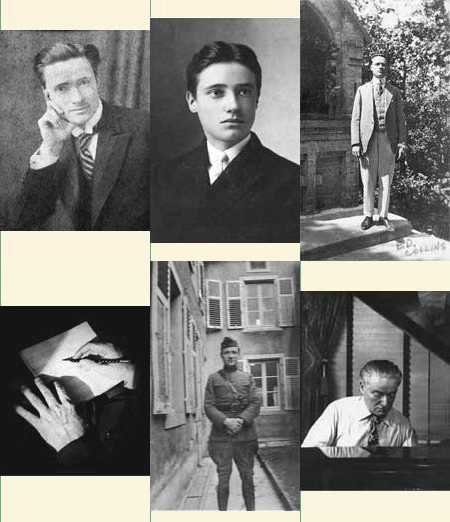
Edward Joseph Collins: An American
Composer
BY ERIK ERIKSSON
Edward Joseph Collins, American composer and pianist, was among those unfortunates to whose career and body of work has been attached the qualifier, “regional.” Despite a number of early years spent in Europe and a brief period as a conductor at New York’s Century Opera Company, he is remembered primarily—if at all—as a Chicago musical figure. Although his mature years found him in Chicago, amidst those cited as belonging to the “Chicago School,” Collins remained musically apart from its members, pursuing his own pathway.
Notwithstanding several large orchestral works, three splendid piano concertos, a grand choral piece, several chamber compositions that include a significant work for violoncello and piano, numerous well-crafted songs and works for solo piano, and an opera that won him the respected David Bispham Award, his music—except for some occasional concerts and recordings—went largely unperformed in the years following his death. Closer acquaintance with his work shows that this neglect was not only regrettable, but has deprived the larger public of familiarity with a composer of exceptional quality.
Perhaps now that tonally centered music has once again gained credibility among the fraternity of music writers/critics as well as the community of musicians, Collins’s music will be rediscovered and welcomed into the American canon of important works.
Sad to say, until this writer undertook a three-part biography for a Midwest arts journal, no extensive biography— other than ones supplied for recordings and program notes based on those provided by family members—had been attempted. While substantial segments of Collins’s life are undocumented other than for notices and reviews of public performances and other activities within his community, his family has been able to provide letters and materials for a connecting narrative.
Even more important is the existence of journals, covering only certain periods in his life but invaluable for revealing the man behind the persona known to friends and members of the public. A life that might have seemed convivial and relatively uneventful was lived on the surface of an inner existence that churned and seethed. Collins anguished over the frequent blockages in his creative flow and chafed over pedagogical responsibilities at a succession of Chicago conservatories that, increasingly, offered minimal rewards and too many stultifying hours spent with sometimes indifferent or untalented students.
The story of these journals, incomplete as they are, is told in this letter written in 1988 by daughter Louise (Ferrarotti) to her siblings. “During his [Collins’s] last week at Passavant [Hospital] dad called me to his bedside and told me to destroy his diaries because they contained bad remarks about some people. That was all he said. I tried to reassure him but the idea of destroying what was a part of that genial spirit was unthinkable.”
After detailing where the journals had been kept from 1962 until the time of her writing, Louise made this comment: “At this point a few facts should be kept in mind. Firstly, the journals were not in my possession; it was guardianship. Secondly, if I had been a really obedient daughter they would have been destroyed in 1951. Moreover, any Victorian attitude toward their content is completely alien to my nature; it would never have occurred to me to burn these precious documents.”
Well-read (both in depth and breadth), Collins was intensely aware of social and political issues, even as he felt more and more estranged from what he saw happening in the world at large. He confided his thoughts to the several little books whose contents were meant to be seen by no one other than the author. His complete candor allows one to feel an immediacy and unfiltered honesty altogether rare in the writings of a musical figure.
continued
|