|
Edward Joseph Collins: An American Composer
(continued)
BY ERIK ERIKSSON
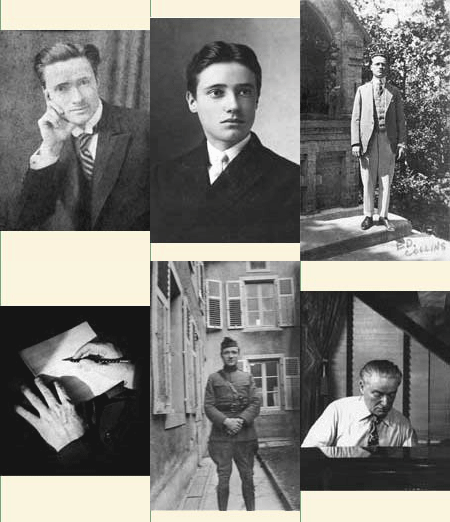
When he returned to Chicago, Collins resumed his performing career, winning this remark from the Chicago Evening American: “Handling grenades and guns in the awful business of battle has not harmed the subtleness [sic] of his talented fingers.” In 1919, he joined the faculty of the Chicago Musical College as one of its principal piano instructors.
In the Windy City, Collins met and, in 1920, married a young voice student Frieda Mayer whose father was Oscar Mayer, the man whose Chicago meatpacking company had made his name a household one. A year later, their first child was born, Dorothy Louise, followed by Marianna Louise (1925), Louise Joan (1929), and Edward Joseph Jr. (1931).
Beginning with the very first entries found in the composer’s journals, journals he had intended to remain unread by any eyes other than his own, Collins unburdens himself on subjects covering the broadest imaginable spectrum—politics, religion (which he had come to reject), philosophy, music and the other arts, family, and frustrations that surround mixing composition with teaching and performing.
In commenting on a performance of Gounod’s Faust on 17 January 1921, he writes, “In short the old faith and fear are gone so ‘Faust’ carries no message. Peculiar that people credit God with being vengeful as well as merciful. Poor humans are so modest; they could also be merciful and be godlike but they praise God when he shows mercy once in a great while and they could be merciful every day.”
In 1923, the Chicago North Shore Festival sponsored a competition for new works for orchestra. From forty-seven scores entered, five finalists were chosen by a panel of judges that included Gustav Strube, Henry Hadley, and George Chadwick. Of those five, two had been submitted by Edward Collins: 1914 (later re-titled A Tragic Overture) and Mardi Gras, described by the composer as “boisterous and bizarre by turns, with now and then a romantic or even serious moment—this latter the constant companion of wild frivolity.”
The five semi-final choices were each performed under the direction of Chicago Symphony Orchestra conductor Frederick Stock at a public rehearsal held in the gymnasium of Northwestern University on 26 May 1923. At day’s end, after having the first-time experience of having heard two of his large works played by orchestra, Collins was awarded the $1,000 first prize for 1914.
Although Stock had been impressed by the 1914 during the competition reading, it was not until three years later that he programmed the piece for an outdoor concert in New York; Stock conducted it again on a regular Chicago Symphony Orchestra concert the following season. The composer himself led a performance with the St. Louis Symphony in 1926 and conducted it in a Symphony Orchestra concert in 1942.
Despite Collins’s concern “that no definite program should be attached to the thematic material,” he did own up to the fact that “in one or two cases it will be impossible to avoid this as the meaning is perfectly clear and obvious,” citing the battle scene and funeral march coda. The work is scored for large orchestra including triple winds and brass, piano, and a sizable complement of percussion.
A Piano Concerto in E-flat major (which would be the first of three) was introduced when Collins appeared as soloist with the Chicago Symphony Orchestra under Frederick Stock on Friday afternoon, 27 March 1925. Dedicated to “friend and teacher” Rudolph Ganz, the final movement was designated ‘Al’Americana’ [sic]. The critics agreed that the work was well constructed and wonderfully played, albeit somewhat short on extended ideas.
By early 1928, Collins had felt himself ready to compose a large work for chorus, soloists, and orchestra called Hymn to the Earth, a setting in cantata-like form his own secular texts in praise of Nature. In September, with most of his family at their Cedar Lake retreat, he was “able to give many precious hours to my ‘Hymn to the Earth.’ It is fast nearing completion and I am elated to think that at last I have entered upon a really serious and creative phase of my life. The symphony comes next.”
continued
|