|
Edward Joseph Collins: An American Composer
(continued)
BY ERIK ERIKSSON
A darker note intrudes, however, as he later discloses in the same entry that, “The discordant note in this harmonious scene is myself; I feel poorly equipped to be the lord and master of a fine estate and a husky family. Now that the children are here and we are alone, I am very aware of my great responsibilities toward them. A sinking feeling comes over me when I think of the poor showing I have made as a husband and father. In any case I am at the crossroads: either I go on leading my mediocre irresponsible life or I become a strong character capable of sacrifice for the sake of achievement. When I am up here surrounded by cleansing and sensible influences, I feel as though I might acquire some husband and father qualities, but in Chicago...!!”
In 1939, Collins was honored with the prestigious David Bispham Award (named after the celebrated American baritone) for his opera, Daughter of the South. In receiving this award, he joined the ranks of such estimable figures as Charles Wakefield Cadman, Victor Herbert, Howard Hanson, Virgil Thomson, Richard Hageman, and George Gershwin. Subsequent winners included Douglas Moore, Gian-Carlo Menotti, Kurt Weill and Sir Michael Tippett. Highly distinguished company.
That same year, however, Collins had second thoughts about the work and wrote of them in his journal on July 11. “Just now I am in the throes of making a decision which has kept me ‘troubled in mind’ for some time. Some people want me to give a performance of my opera at a local theatre; now I am not satisfied with ‘The Daughter of the South.’ The libretto needs to be revised in the first place; I wrote the music and as I went along [sic] which I have found out is a fatal procedure. In other words I created situations to fit the music and thought up new incidents as soon as I had caught up with myself.” He also was concerned about a production that would be a less than professional one, even if the principals had “beautiful voices.” He anguished over the fact that “the Lake View Musical Society is honestly trying to help me, a local composer, put on an American work. I appreciate their sympathy but when I see the dear old ladies in the chorus, I could burst out laughing.”
The next day, Collins confides to his intimate volume, “I become terribly sick of Beethoven at times, also of Chopin and Rachmaninoff, but I never tire of Bach or Mozart.”
Collins had a penchant for fast driving. A 13 July 1931 journal entry records one of many fast automobile trips Collins undertook. This one, a late drive to Cedar Lake, left him shaken in retrospect. “It must have been 8:30 before we were under way so darkness soon enveloped us. I had many narrow escapes turning corners and being blinded by oncoming cars. It is a miracle that we do not go off the road in such moments.”
A 24 July 1939 journal entry touches on Collins’s growing despair with teaching. “This has been the worst summer session in my experience; the prices we get are very low and at the end of the term the Conservatory is not able to collect half the tuition. Everybody is broke and the lack of interest is appalling.”
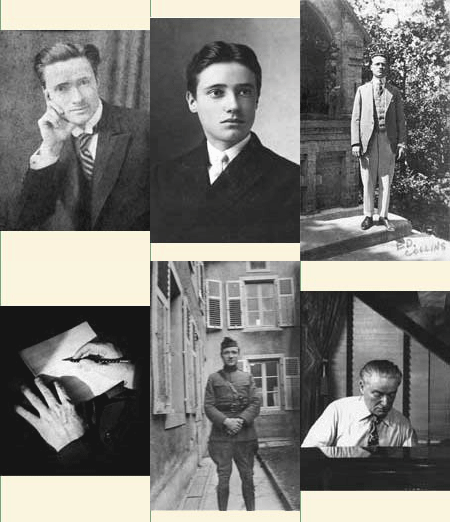
For the last decade of his life, Collins struggled with the effects of congestive heart failure, suffering three heart attacks (the first in late spring 1940). The well filled-out features of the 1930s gave way to his more leonine, quite distinguished appearance, during the 1940s.
Yet in 1943 Collins played the very challenging solo part of his 3rd Piano Concerto, for the world premiere performance of the Chicago Symphony Orchestra. His son Edward Jr. has commented that, during this time, Collins’s home in Fish Creek had a salutary effect on his energy. Walks to town and the fresh air of the peninsula sustained him at a time when strength was ebbing.
The composer finally succumbed in Chicago on 1 December 1951 at the age of sixty-five.
In Closing
The music of Edward Joseph Collins rewards close scrutiny and merits frequent performance. While one can point to the presence of devices employed by other composers, the fact is that Collins was highly original in his organization and employment of ideas, in the flow with which they were assembled, and in the unforced introduction of American idioms to works that were conceived with great seriousness of purpose. His works dwell outside the easy categorization many critics and listeners commonly apply.
Whatever disappointments Collins may have experienced in life, his works show strength of character and a courage that must be admired—and an endearing capacity to convey genuine and enduring emotion.
Original version, 2001; Eriksson revision, February 2007. Updated by Jon Becker, 2012 and 2016.
|