|
Edward Joseph Collins: An American Composer (continued)
BY ERIK ERIKSSON
Collins later recalled his experience at the German holy of holies with these remarks: “An objective criticism of the Bayreuth master would be to grant him great dramatic power hampered by his overweening conceit.” And again, “When I saw the performance of ‘Rheingold’ at Bayreuth in 1914 I could not restrain a laugh at the sight of Thor with his hammer. They also gave the ‘Flying Dutchman’ [conducted by Siegfried Wagner] that summer and I was amazed at the dullness and ridiculous character of the work. But then came a performance of ‘Siegfried’ that was daemonaic [sic] in its effectiveness.”
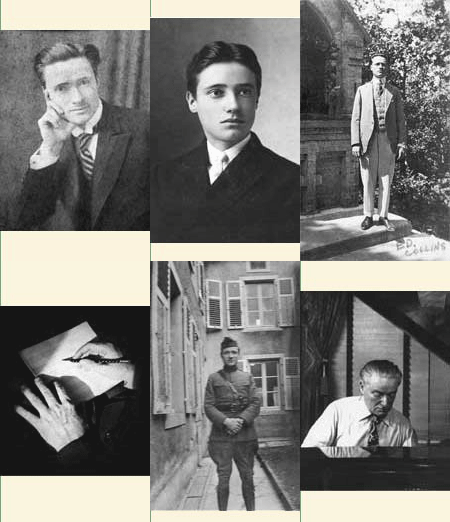
Returning to Chicago, he found anything but stagnation. The 23 February 1917 edition of Chicago’s Music News featured a photo of Collins on the cover and two items within, one an announcement of a recital scheduled for Sunday afternoon, February 25, the other a half-page story outlining his career to date. The biographical piece begins with the claim that Collins is “Among the most successful, as he is certainly among the most talented of American artists....” In the next paragraph, “No young pianist of the World today—American or European—has attained a more prominent success.”
The article, presented without byline, offers more effusive praise, assuring the readers that “Mr. Collins has the entire equipment—technical and temperamental—to make him famous as a pianist of the utmost charm, and to this he adds an unlimited repertoire but, he prefers to be known rather for his thorough musicianship and his versatility.”
The article observes some of his recent activities, particularly as a conductor. It cites his “conducting the Chicago Symphony Orchestra at the Festival of Civic Music at Orchestra Hall and many appearances as orchestra and choral Conductor at various Civic Centers throughout the city.” It notes as well that, “as a teacher of piano, he is becoming known as one of the best in America and has at present a large class at the Bush Conservatory.”
Upon the United States entry into World War I, Collins found himself in uniform as an infantry private. He soon rose to the rank of Lieutenant, serving in the 88th Division Intelligence Unit in France, receiving a citation for bravery. His facility with the German language made him of great value as an interpreter and he also served by entertaining the troops as a pianist, accompanist, assembler of concerts, and composer of a musical.
His operetta, Who Can Tell?, co-authored with Hal Greer, proved a resounding success. The souvenir booklet, issued by the Clover Leaf Publishing Company of Chicago, notes that “For beauty and lavishness ‘Who Can Tell’ was conceded to be easily the finest thing produced by the American Expeditionary Force in France. The Jewish Welfare Board, which financed the show, spared no expense in making the production a theatrical marvel.”
Indeed, the nine production photos contained within the booklet show clearly the sumptuousness of the set design and costuming. Top-hatted men provide an elegant counterpoint to the numerous young ladies (interesting as this may have been an all-male cast!) who appear in a variety of regalia—from contemporary garments to period frocks with parasols. Something a little more exotic is shown for the ‘Persian Scene,’ and there is another tableau titled ‘Show Girls.’
Who Can Tell opened in Gondrecourt, then the headquarters of the 88th Division. Playing for three weeks, during which all the division personnel attended performances, it traveled into Germany where it was performed for the army of occupation, and then was taken to Paris for eleven nights at the Champs Elysses Theatre. The booklet reveals that at one of these Paris performances—all to capacity crowds— “President Wilson and his party were among the most enthusiastic in the audience.” Following the Armistice, John Philip Sousa appointed Collins bandleader, a position that Collins held until his release from service.
continued
|