|
Edward
Joseph Collins: An American Composer (continued)
BY ERIK ERIKSSON
A convivial man, one who enjoyed the company of friends, Collins often partied late into the night. The next day found him berating himself for what he viewed as failures of application and self-discipline. Still, while he was in Chicago, the pattern was difficult to break and he continued the cycle of nighttime socialization followed by regret and resolve the next day. Even more, these writings reveal the loneliness of the creative man—the individual who is sensitive to the darker side of many with whom he must interact and who struggles with his work even as he deals with those who he feels have ignored what is most noble in man.
In his own compositions, he moved steadily away from the mix of German counterpoint and Romanticism that had been his daily bread while a student in Berlin and responded to a growing affinity for the impressionists of the early twentieth century. Debussy was increasingly valued (Clair de Lune was a composition that never failed to draw a rapturous response when he performed it). Ravel became perhaps the most significant of all icons.
Having married Frieda Mayer and thus into a family of wealth, Collins’s middle years were spent with his wife and young family in the large and art-filled Mayer residence on Sheridan Road in Chicago (at the very corner where today Sheridan Road and Lake Shore Drive intersect). His father-in-law Oscar was an avid follower of Post-Impressionist art and a devoted partisan of the Taos School: the walls of the home were three tiers deep with his estimable collection.
Collins valued time away from Chicago for the opportunity it brought for creativity as well as a sense that he was master of his own domain, even if—initially—it was a rented one. Despite the troublesome need to maintain and update the property he eventually purchased in Door County, Wisconsin, he welcomed the feeling that he had, at last, gained ownership of his own home.
The Composer’s Life
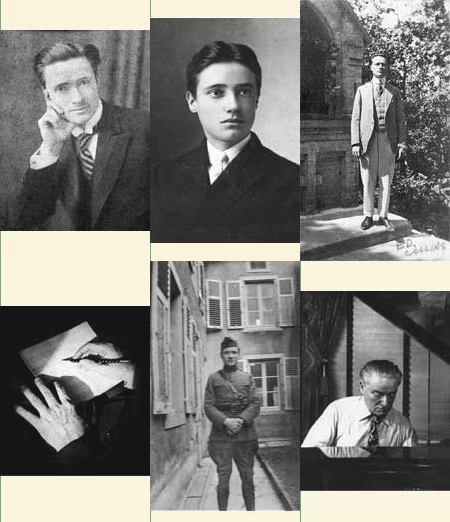
Collins was born in Joliet, Illinois on 10 November 1886 to Irish-American parents. While previous biographies had given his birth year as 1889, data from both the 1900 U. S. Census and St. Patrick’s Parish birth and baptismal records confirm the earlier date. Edward was the youngest of nine children born to Peter and Bridget (McIntyre) Collins, both of whom came from Ireland—he from County Meath in the north, she from Belfast—and were active in the Catholic parish, around which family activities frequently revolved.
All of the nine children exhibited musical talent at an early age, and Edward’s gifts were allowed to manifest themselves under the encouraging guidance of his siblings. By the age of nine, he was already giving concerts in his own community.
He later recalled his first teacher, Mr. Shafer as “a splendid type.” Shafer was uncompromising as he “scathingly denounced all and sundry pretenders to musicianship.” Collins learned years later that Shafer had died poor and alone.
At the age of fourteen, Collins began instruction under Rudolf Ganz in Chicago. Advancing at a remarkable pace, he was invited by Ganz in 1906 to travel with him to Berlin to study further at the Königliche Hochschule für Musik. There his instructors in composition, organ performance, ensemble playing, and conducting included Max Bruch, Robert Kahn, Friedrich Gernsheim, José Viana da Mota, and Englebert Humperdinck. He played timpani in the school orchestra for four years and took advantage of every opportunity to conduct school ensembles.
continued
|