|
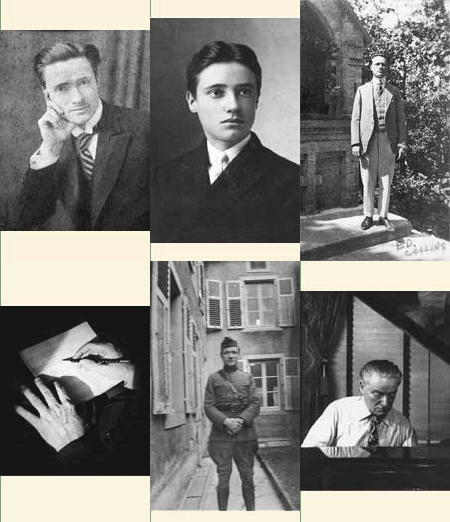
Edward Joseph Collins: An American Composer
(continued)
BY ERIK ERIKSSON
The beginning of 1939 gives us a picture of rare exuberance as Collins tells his paper confidant that: “This will be my big year; the gods have told me so. This time next year I shall be world famous and rich—the latter not for myself but for those who love me. They will have money and they will be happy, but I shall have the world at my feet and shall be hailed as a genius.” The following day, however, his family entertained a lady from Germany who was in fear of the Gestapo but who was of mixed feelings on the Jewish question. “She had many Jewish friends and many times during the last year she has been ashamed to be a German.” But, on the other hand, “when she spoke of Hitler the conqueror her eyes sparkled and she betrayed herself as the German who is out to dominate the world.”
14 January 1939 brought the completion of his opera, Daughter of the South. With the work now behind him, Collins turned his attention to a broadcast from the Metropolitan Opera of Mozart’s Don Giovanni. His journal entry reveals, “I was overwhelmed by the work. This is surely Mozart’s masterpiece. It gathers momentum up to the final scene where it probably transcends even Beethoven and Wagner in dramatic power. How subdued we are in the presence of genius! It become a miracle, a revelation and we are struck dumb. Criticism is ridiculous.”
Over the next days and months, Collins’s entries offer many pointed opinions. “The president is supposed to be a smart man but I think he is stupid—or rather he is probably a sick man. He may be a master of detail but he overlooks the fundamentals.” “Roosevelt’s misguided humanitarianism makes him the poor man’s misfortune.”
“Johann Sebastian Bach—first citizen of Germany. I wonder if the German people realize how well he represents them, not only by his musical genius but by his twenty children. The home life of Bach is the thing that made Germany great and he is the real Germanicus.” “I really believe that the jazz pianists are better musicians than those who are giving their life blood to master the classics. I know for instance that Eddy Duchin is a better musician than Josef Lhevinne even though the later can play a number of concerti quite flawlessly. If I had it to do all over again I should keep up with the popular music and be able to play all the well-known tunes in any key.”
“My father-in-law’s birthday [29 March 1939]. He is eighty today. There is something terrible about eighty when the owner of the years is still alert and in love with life as much as Mr. Mayer is.” “In the morning I finished ‘Didn’t My Lord Deliver Daniel’ (the other day I bought an amazing collection of spirituals and am going to make piano pieces of them).”
Collins confided to his journal in a 27 May 1939 entry that, “Cedar Lake and Fish Creek are beautiful to me not only on account of the fresh air but also because in these places I am free to do the work I love and because I am away from all the irritating distractions of Chicago.” He continued by noting that, “Fish [Creek] is a different climate—probably ten degrees colder than Chicago and quite blustery. It is a place where one might become very lonesome at night.”
“We came here to begin getting our house in ready for the summer. It is a new experience for me and I don’t feel quite equal to it. This afternoon, for instance, I talked to Mr. Gannett our caretaker about what is to be done; during the next ten days I shall be busy talking to electricians, plumbers, caretakers and all the people who make a house livable after it has been empty for ten years.”
A July 8 journal entry from that first year in his own home shows Collins to have been pleased by the final results: “A more charming country house than ours is not to be found on this earth. Sitting out in front of it now I am looking over the tops of our two hundred cherry and apple trees to the meadow beyond where hay has just been cut and raked into little stacks.” He comments also that, “To the north is our beautiful birch grove where by next year I shall have my little log studio [it turned out to be fieldstone, and located to the south of the house] with my piano and stacks of manuscript paper—far enough away from the house so that I shall not hear the radio or the noisy children.”
continued
|